
Evaluating electrical-calcium-contraction coupling
Cardiac excitation triggers intracellular calcium changes that drive contraction. Bringing electrical activity, calcium handling and mechanical responses into one research framework helps identify where drug-induced changes occur and whether different functional processes show concordant or dissociated responses.
Research models
Studies can use primary cardiomyocytes, iPSC-derived cardiomyocytes, cardiac organoids and cardiac-like tissues. Model origin, maturation in culture, tissue thickness and accessibility for measurement influence the experimental approach and interpretation.
An integrated functional assessment framework
| Functional process | Measurements and analysis |
|---|---|
| Electrical activity | Patch-clamp action potential recording or voltage imaging; extracellular field potentials can be included for suitable samples. |
| Calcium handling | Calcium transient amplitude, rise and decay, rhythm and regional activity. |
| Mechanical responses | Contraction and relaxation kinetics, motion phenotypes, or mechanical measurements under appropriate conditions. |
| Analysis across processes | Compare concentration responses, time responses and abnormal events to identify differences between functional processes. |
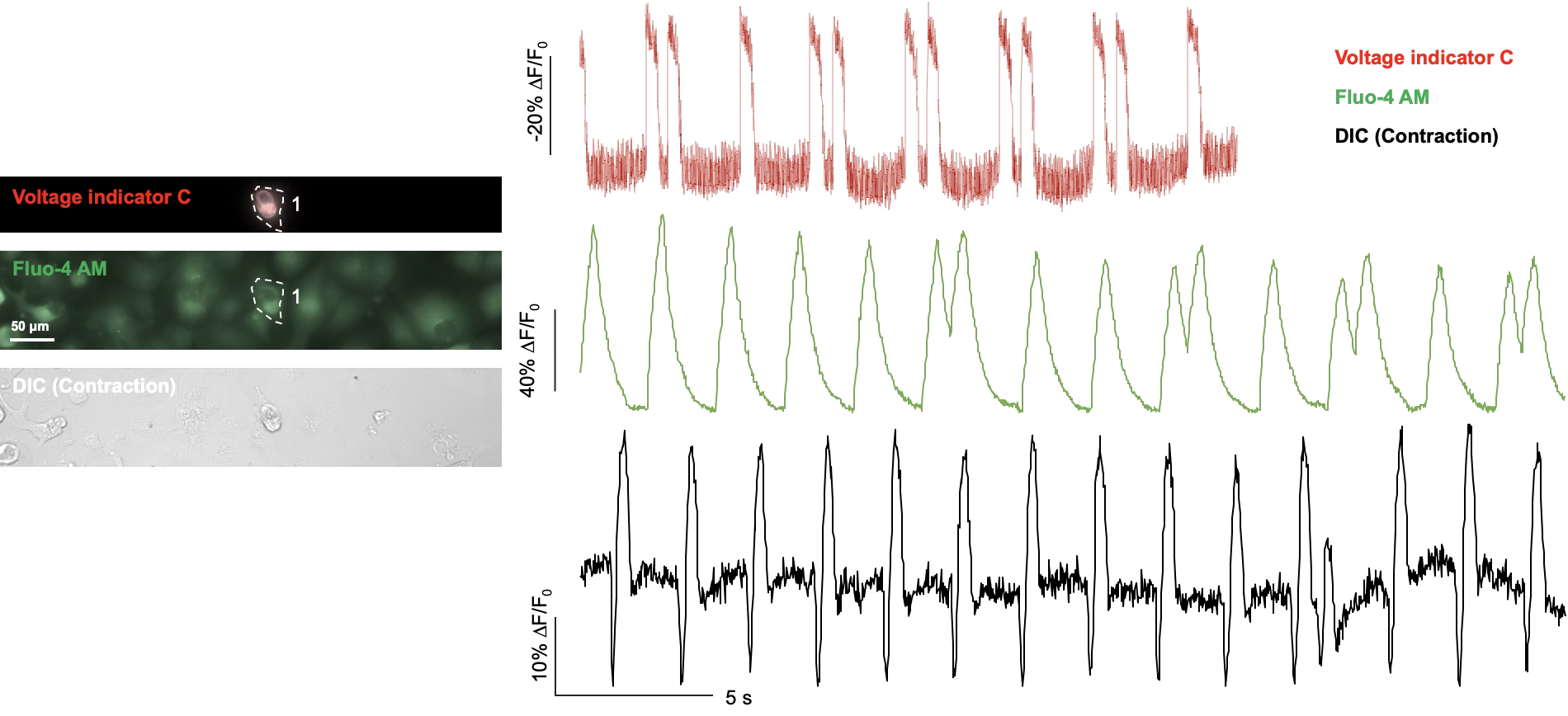
Depending on model and assay compatibility, the study combines measurements that can be performed on the same sample, or uses matched samples under common treatment conditions. Delays between functional processes and beat-to-beat correspondence are analyzed only when acquisition provides reliable temporal alignment and meets the relevant quality requirements. Integrated assessment does not imply simultaneous three-signal acquisition in every model.
Optical voltage signals are not direct measurements of absolute membrane potential. Motion or beating-related impedance signals should not be interpreted as direct contractile force without an appropriate mechanical measurement and calibration.
Example of complementary functional measurements
Research applications
- Determine whether changes in electrical activity are accompanied by altered calcium transients and contractile responses.
- Investigate relationships between abnormal calcium handling and changes in contraction or relaxation.
- Compare the sequence of functional changes and their recovery across concentrations and exposure durations.
Correlation analyses provide clues for mechanistic research. Identification of a specific ion channel, calcium-handling protein or myofilament target requires additional targeted validation experiments.
Project design and deliverables
The model, treatment concentrations, exposure times, control conditions and replicate design are agreed according to the study objectives. Results are analyzed alongside sample-condition and quality-control information.
- Description of the assay combination, sample-matching strategy and temporal relationship between acquisitions.
- Individual results for each functional endpoint and an integrated analysis across measurements.
- Interpretation of abnormal phenotypes, limits of the evidence and directions for further validation.