
Neuronal Electrophysiology Platform
Our primary rodent brain neuron culture platform combines electrophysiology and imaging to generate functional and translational data for central nervous system (CNS) drug discovery. It supports ion channel, G protein-coupled receptor (GPCR) modulation and synaptic function studies, with different throughput options for small-scale compound screening and mechanistic research.
Cellular patch clamp is a gold-standard method for directly measuring membrane potentials and ionic currents in individual cells. It enables quantitative investigation of neuronal excitability, ion channel function and synaptic signaling under physiological and pathological conditions. Controlled in vitro preparations support stable, reproducible recordings from healthy, functionally mature neurons.
Our broader cellular electrophysiology service includes whole-cell current-clamp and voltage-clamp recordings from primary rodent brain neurons, rodent dorsal root ganglion (DRG) sensory neurons and human iPSC-derived neurons generated from donor cells. These complementary models connect molecular mechanisms with cellular function; their capabilities remain part of this service alongside the primary brain neuron platform.
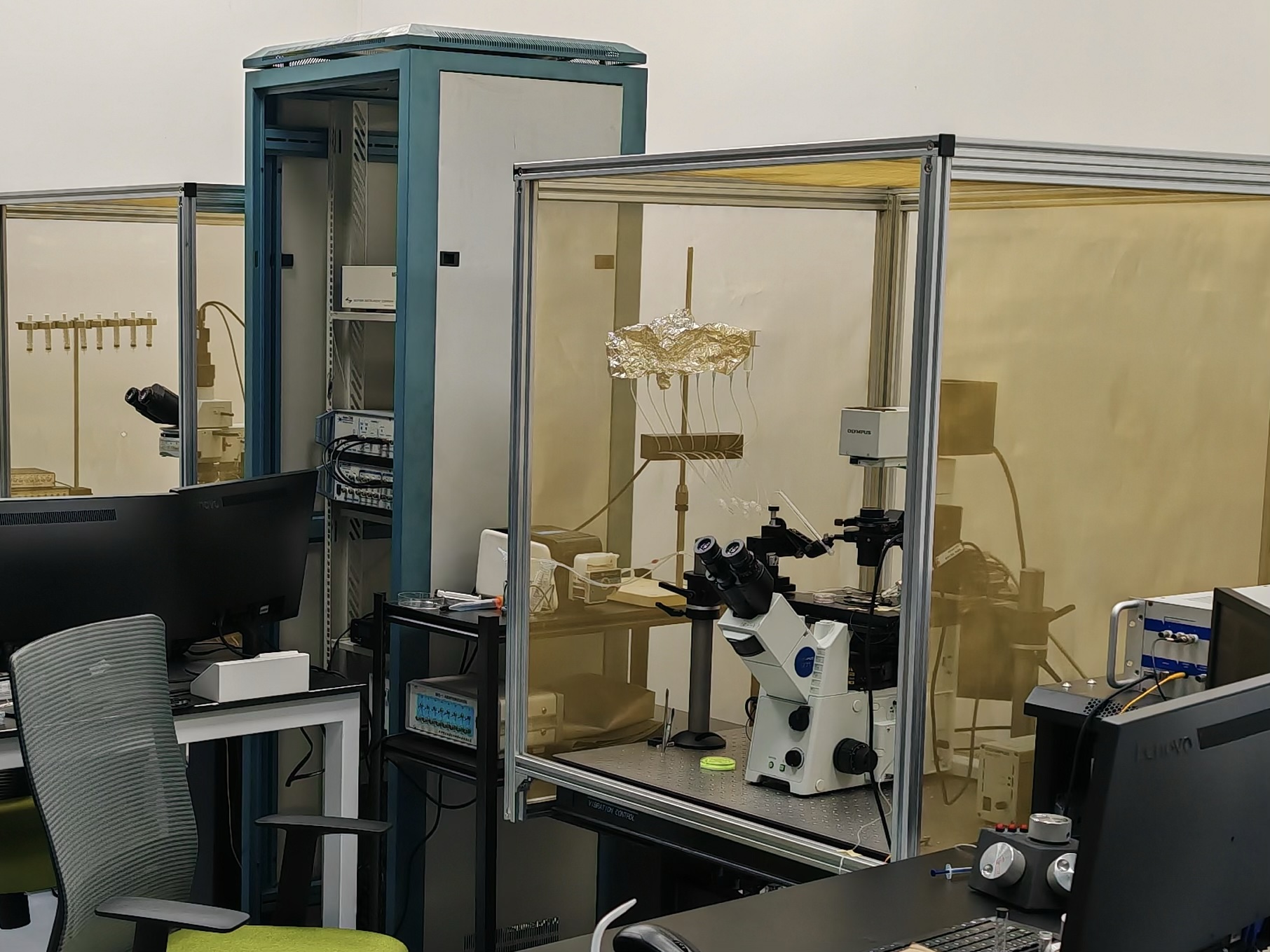
Primary Brain Neuron Sources
Primary neuronal cultures are available from several rodent brain regions:
- Hippocampus
- Cortex
- Striatum
- Cerebellum
Recording Methods and Applications
Patch Clamp
- Passive membrane properties: input resistance, membrane capacitance and resting membrane potential.
- Active membrane properties: firing threshold, action potential amplitude and firing frequency.
- Channel studies: voltage- and ligand-gated ion channels and GPCR-mediated modulation.
- Synaptic transmission: evoked, spontaneous and miniature currents in suitable neuronal cultures.
Calcium Imaging
- Studies of small neuronal subpopulations.
- Visualization of action potential-dependent calcium signals.
- Evaluation of drug effects and network activity patterns.
Voltage Imaging
- Studies of larger neuronal populations.
- Real-time monitoring of membrane potential changes.
- Identification of neuronal subpopulations by their responses to pharmacological intervention.
Applications Across Cellular Models
- Functional evaluation of ion channels and receptors in defined neuronal populations.
- Electrophysiological assessment of compound effects on neuronal excitability.
- Disease modeling using DRG and human iPSC-derived neurons.
- Mechanistic studies supporting target validation and lead optimization.
Cellular Patch-Clamp Workflow
A standard workflow includes neuron culture or preparation, electrophysiological stabilization, formation of a high-resistance seal, and whole-cell current-clamp or voltage-clamp recording. These measurements provide high-resolution functional analysis at the single-cell level.
Studies using primary rodent neurons, DRG sensory neurons and human iPSC-derived neuronal models support translational neuroscience and CNS drug discovery. Assay design is customized to the experimental question.
- Voltage- and ligand-gated ion channel characterization.
- Neuronal excitability profiling under pharmacological modulation.
- Synaptic current analysis in cultured neuronal networks.
- Study-specific protocol and assay design.
Model-Specific Functional Measurements
Current-clamp and voltage-clamp protocols are selected separately for the biological question. Synaptic assays require an appropriate neuronal network; a result from one neuronal subtype is not assumed to represent every subtype.
- Primary CNS neurons: action potential firing, membrane properties and, in suitable cultures, spontaneous or miniature synaptic currents.
- DRG sensory neurons: excitability, firing thresholds and selected voltage- or ligand-gated currents for pain-mechanism and pharmacology studies.
- Human iPSC-derived neurons: functional maturation, between-group differences and compound responses, interpreted with differentiation history and cell identity.
Experimental Controls and Reporting
Study planning defines culture age, cell selection, stimulation, compound exposure, vehicle controls and replication. Recording quality is assessed using seal and access resistance, membrane stability and other protocol-specific criteria.
Reports can include raw current or voltage traces, action potential and current parameters, concentration-dependent effects when studied, and group-level summaries. Replicate definitions and exclusions are stated so that cell-level measurements are not mistaken for independent donor or animal replicates.