
hERG Screening Services
We provide patch-clamp hERG screening to support early cardiac safety research in drug discovery. The standard workflow covers sample handling, current recording, analysis and reporting.
- Client sample preparation
- Sample receipt and registration
- Patch-clamp experiments to record hERG currents
- Data analysis and interpretation
- Report delivery
Why Assess hERG Inhibition Early in Drug Discovery?
The hERG potassium channel forms the pore underlying the rapid delayed rectifier potassium current, IKr, which contributes to cardiac repolarization and action potential duration (APD). Inhibition can delay repolarization and is relevant to QT/QTc prolongation. Torsades de pointes (TdP) is a potentially serious ventricular arrhythmia that can progress to ventricular fibrillation or sudden death.
Several drugs withdrawn because of QT prolongation or TdP were found to inhibit hERG. The ICH S7B and E14 guidelines, introduced in 2005, established complementary nonclinical and clinical approaches to evaluating delayed repolarization and proarrhythmic potential. Early hERG screening helps identify a potential electrophysiological liability and prioritize compounds for further investigation.
A hERG result alone does not establish clinical QT prolongation or TdP risk. Interpretation requires the experimental conditions, exposure context and other relevant evidence; risk cannot be determined from a single universal QTc cutoff. These exploratory non-GLP studies do not replace an integrated cardiac safety assessment or a regulatory study package.
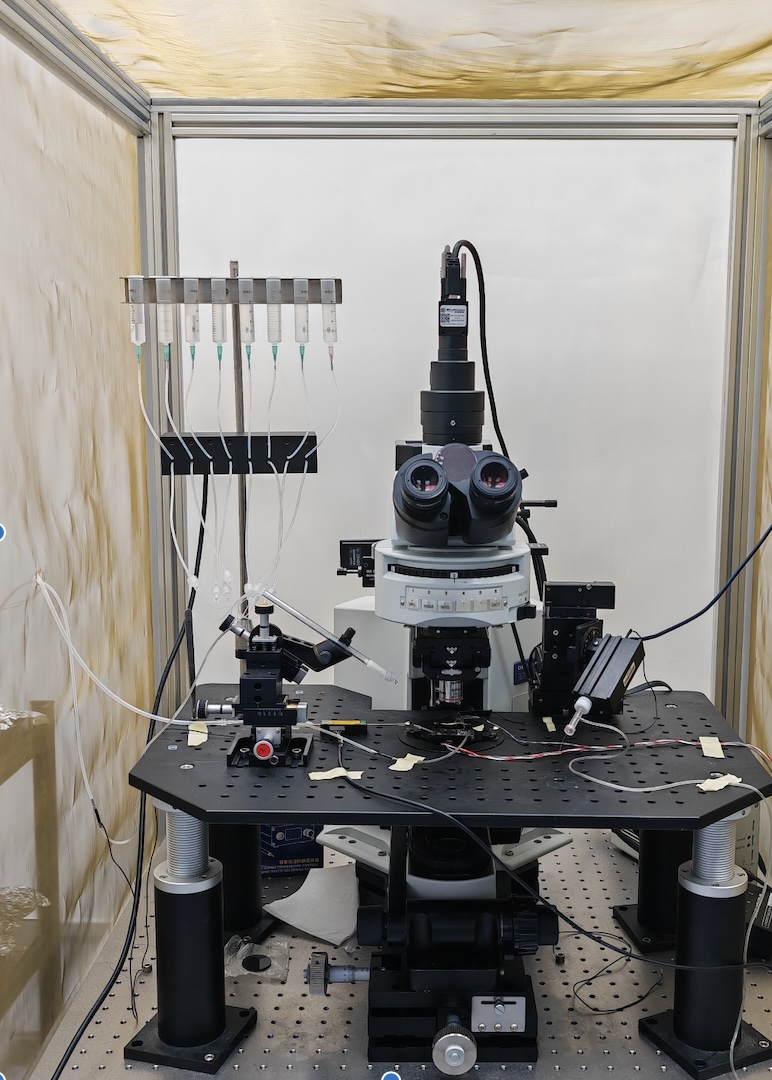
Recording Quality and hERG Inhibition Analysis
Although early discovery screening can be performed outside GLP, a well-characterized experimental system remains important for interpretable inhibition data and half-maximal inhibitory concentration (IC50) estimates. Study design balances data quality, throughput, cost and turnaround. Our hERG screening service is non-GLP and is intended for discovery-stage research.
Recording acceptance criteria address seal quality, access resistance, baseline current stability and adequate compound exposure. Solubility, vehicle tolerance, current rundown and reference-compound responses are considered when interpreting inhibition. Test concentrations, vehicle, exposure duration, voltage protocol, recording temperature and controls are defined before the experiment and reported with the results.
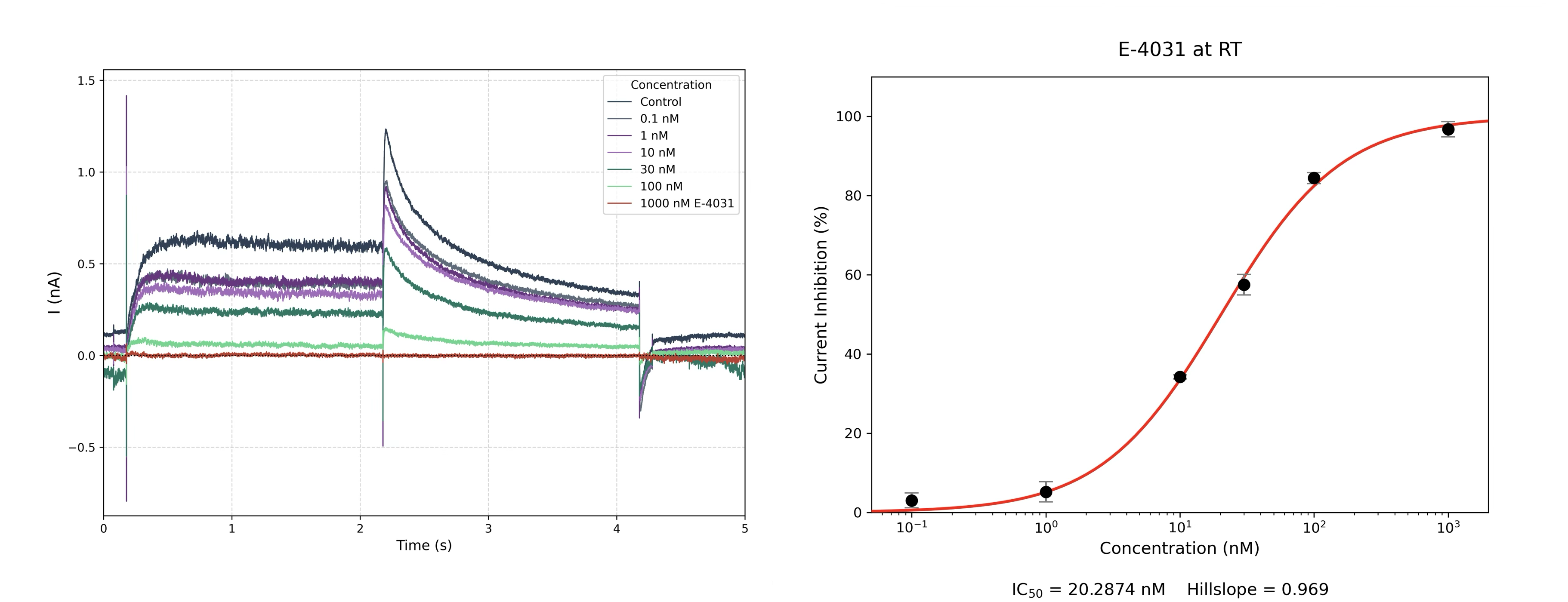
IC50 estimation requires sufficient concentration-response information. If the tested range does not support a reliable fit, the report presents the observed inhibition and explains the limitation instead of forcing an estimate. Single-concentration screening is not equivalent to a complete concentration-response study.
Selecting a Patch-Clamp Approach
Automated patch clamp offers throughput and standardization advantages. Its suitability, like that of manual recording, depends on the platform, cell preparation, protocol and acceptance criteria. The following issues should be assessed for the intended study rather than assumed to affect every automated system:
- Seal and whole-cell access: assess seal resistance, access success and their effects on voltage control and data quality.
- Protocol flexibility: confirm that the required stimulation and perfusion protocols can be implemented.
- Cell preparation: establish acceptable suspension uniformity and viability.
- Visual assessment: determine whether cell morphology and seal formation can be monitored as required.
- Low-expression channels: assess whether small currents can be resolved with adequate signal quality.
- Long recordings: verify seal and current stability over the required exposure period; a prolonged recording alone does not establish chronic toxicity.
Manual patch clamp provides flexible cell selection and protocol adjustment for hERG inhibition studies, detailed kinetic analysis and mechanistic research. Method selection should be supported by performance under the actual study conditions, not by a blanket claim that one platform is always more accurate.
Manual Patch-Clamp Study Formats and Deliverables
Manual whole-cell patch clamp is used for single-concentration screening or concentration-response testing. Recording temperature and other protocol requirements are agreed for each study; physiological-temperature testing is not implied for every standard screening experiment.
Outputs can include representative current traces, inhibition at the tested concentrations, concentration-response plots and fitted parameters where justified. The report documents methods, recording conditions, sample numbers, exclusions and analysis assumptions, with interpretation appropriate to an exploratory non-GLP study.